We recognize the reality of running a contracting company usually involves wearing too many hats. You might be answering client calls at dinner, estimating jobs on weekends, and putting out fires on site all week.
Our experience shows this level of owner dependency severely limits your potential.
This hidden bottleneck quietly ensures your company can never grow beyond your personal capacity. We will break down how to reduce owner dependency in your contractor business and outline a clear framework to regain your freedom.
Why Owner Dependency Develops
Most contractor businesses start with the founder doing the actual field work. You were the best estimator because you had the most hands-on practice.
Our team sees this pattern constantly across the US construction industry. A March 2026 report from ZipRecruiter shows the average US construction business owner earns about $127,973 annually. That income often comes at a massive personal cost.
We consistently hear from owners who work grueling 80-hour weeks to hit those numbers. A late 2024 study by The Aspire Institute confirmed this exhausting trend among general contractors. You keep the high-value functions like sales and financial management because those feel too important to hand off.
Our consulting work reveals how the business eventually grows entirely around you as the central hub. Every important decision suddenly flows through your phone.
Here are the clear signs you have become the bottleneck:
- Every estimate waits for your final review.
- Important customers refuse to talk to anyone else.
- Your phone rings constantly during your planned vacations.
- Project delays happen the minute you step off the job site.
The Five Functions You Must Delegate
Systematically transferring responsibilities is the only way out of this trap. You cannot hand off everything at once without causing chaos.
Our strategy focuses on the five critical functions that keep most owners stuck. Let’s look at exactly how to tackle them.
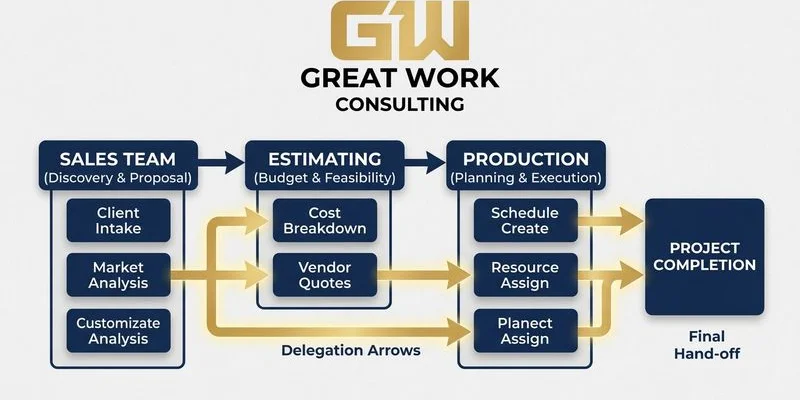
1. Sales and Estimating
This area is usually the hardest function to let go of because it directly impacts your revenue. You likely believe nobody knows the product or the customer quite like you do.
Our approach focuses on building a repeatable sales system instead of finding a perfect clone. A competent person executing at 80% of your effectiveness can still dramatically increase total output.
We recommend implementing standardized pricing templates and clear objection-handling scripts. You can support this shift using a few strategic steps:
- Implement specific CRMs: Use industry-specific tools like QuoteIQ for AI-driven estimating or JobNimbus for specialty contractors.
- Review consulting resources: Our CRM and marketing automation consulting page provides specific guidance on building automated systems.
- Start shadowing: Have a team member shadow site visits for three months before they lead visits alone.
Over twelve months, you can confidently transfer the majority of sales activity.
2. Project Management
Your personal capacity puts a hard ceiling on revenue if you manage every single job yourself. You simply cannot oversee more than a handful of active projects effectively.
Our clients who adopt digital management software see massive improvements in their daily operations.
A 2026 Tasa report highlighted that mid-sized contractors using digital tools cut project overruns by 30%.
We advise hiring or promoting a dedicated project manager immediately. You must document your quality standards and create strict inspection checklists. Popular US platforms like Procore work well for large commercial projects, while Houzz Pro serves small residential contractors perfectly.
Your daily job needs to shift from managing projects to managing the project manager.
Our experience shows the transition will involve some mistakes early on. Accept those minor errors as the cost of building a scalable enterprise.
3. Financial Management
Many owners create massive bottlenecks by handling all the bookkeeping and purchasing approvals personally. This habit chokes your cash flow and delays basic material orders.
Our financial consulting services help contractors build the infrastructure needed to step away from daily transactions. You need basic financial controls to protect the company while you step back.
We always tell owners to set clear approval thresholds and use purchase order systems. A 2025 finding from the Illinois Roofing Institute suggests the following financial habits:
- Keep separate bank accounts for payroll, taxes, and operating expenses.
- Reserve 25% to 30% of every payment immediately for taxes.
- Build a 2% to 3% warranty reserve fund to handle future issues without stressing cash flow.
Your new role should focus on reviewing monthly financial reports with an accountant. Hire a bookkeeper for the daily receipts and invoice chasing.
4. Customer Relationships
A major dependency problem exists if clients insist on talking only to you. This situation means your personal brand has completely overshadowed your company brand.
Our team frequently sees businesses lose major clients the moment the founder takes a vacation. Industry data from 2025 shows up to 85% of roofing and construction companies fail within five years, often due to poor communication scaling.
We help owners build a system-driven customer experience rather than a personality-driven one. Automated project updates and standardized check-in calls create reliable consistency.
You should introduce your team members to customers very early in the relationship. Position your staff as the primary contacts so clients build trust with the company itself.
5. Hiring and Training
Workforce development stalls completely when you personally interview and train every single new hire. You simply cannot scale your crew faster than your personal calendar allows.
Our research shows labor shortages remain a massive hurdle across the US market. The Associated Builders and Contractors projected the industry needs 349,000 net new workers in 2026 just to meet demand.
We suggest documenting your exact hiring criteria and building a structured interview process. Create training programs that utilize simple skill assessments and visual checklists.
Empower your managers to:
- Hire within the clear guidelines you establish.
- Train their own specialized teams.
- Handle terminations without your direct involvement.
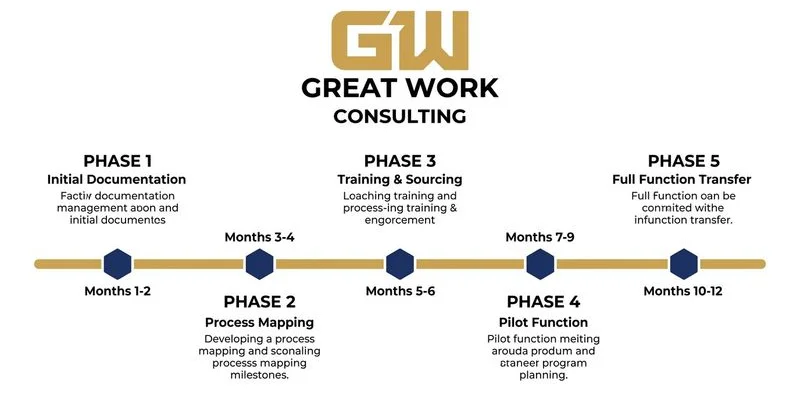
The Delegation Framework: From Doer to Leader
Reducing your involvement follows a highly predictable pattern for each function. You must move through these specific phases to ensure lasting success.
Our methodology breaks this process down into five manageable steps.
Phase 1: Document
Write down exactly how you execute the task. You must create procedures, templates, and standards before handing anything off.
Phase 2: Shadow
Have the designated team member watch you perform the function.
Our best advice is to explain your decision-making process aloud and answer their questions in real time.
Phase 3: Supervised Execution
Let the employee do the work while you observe closely. You can provide immediate feedback and correct mistakes before they become ingrained habits.
Phase 4: Independent Execution with Review
They handle the function independently while you review the results periodically.
We usually recommend checking in weekly at first, then transitioning to monthly reviews.
Phase 5: Full Transfer
They own the process completely. Your only remaining role involves strategic oversight through high-level reporting.
Achieving meaningful freedom typically takes 18 to 24 months of sustained effort.
The Financial Impact of Reducing Owner Dependency
Stepping away from daily operations directly and dramatically increases your company valuation. Buyers look for a transferable enterprise rather than a demanding, high-paying job.
Our market analysis shows a stark contrast between owner-reliant firms and systematized companies.
| Business Type | Average Valuation Multiple | Typical Owner Role |
|---|---|---|
| Owner-Reliant Firm | 2.55x EBITDA | Highly involved in daily operations |
| Systematized Enterprise | 5.0x to 7.8x EBITDA | Strategic oversight and planning |
Data from Clearly Acquired in late 2025 shows private construction businesses typically trade at an average of 2.55x EBITDA. Larger or highly specialized operators with low owner dependence consistently achieve multiples between 5.0x and 7.8x. A recent Midwest case study from Performance Financial CPA showed systematized general contractors reaching up to 5.2x EBITDA.
We detail exactly how these metrics work in our guide on how to value a contractor business. The investment in building a management team pays for itself multiple times over at exit.
Common Objections and How to Overcome Them
Many owners resist stepping back because they fear a drop in quality or customer satisfaction. These concerns are valid but easily solved with proper planning.
Our team hears the same few excuses during nearly every initial consultation. Let’s address the most frequent roadblocks holding you back.
| Common Objection | The Reality | The Solution |
|---|---|---|
| ”Nobody can do it as well as I can.” | You are right, but a team of three delivering 80% quality outproduces you alone. | Implement rigorous training and accept that 80% improves with consistent feedback. |
| ”I cannot afford to hire a manager.” | You actually cannot afford to stay small. | Calculate your personal revenue ceiling. A $75,000 manager who brings in $300,000 in new capacity is a pure profit play. |
| ”My customers expect to work with me.” | Most clients just want professional, reliable service and clear communication. | Introduce your project managers early and position them as the dedicated project lead. |
| ”I tried delegating before and it failed.” | Dumping tasks without building a framework always fails. | Build the process first, train the person thoroughly, and reduce your involvement slowly. |
Start With One Function This Quarter
You do not need to overhaul your entire operation by next week. The smartest approach is picking the one area that consumes the most of your time.
Our clients see the fastest relief when they tackle their biggest daily bottleneck first. Document that single process and begin the five-phase transfer.
We guarantee you will meaningfully reduce your involvement in that area within 90 days. Applying this exact method to all five functions over 18 months creates a company that operates independently.
The final result is a business that provides:
- A highly profitable, scalable enterprise.
- Complete freedom to work on strategy instead of daily tasks.
- A highly valuable, turnkey asset that buyers love.
For strategic guidance on structuring this transition, visit our exit strategy and business valuation consulting page.
Ready to start building a contractor business that runs without you? Book a free Contractor Business Audit and we will assess your current owner dependency. Our experts will identify the highest-impact function to delegate first and create a systematic transition plan.