Our team consistently sees contractors struggle with logistics as they scale to multiple crews. A 2026 report from the Anchor Group shows the US construction industry loses $177 billion annually to these exact inefficiencies.
We find that implementing project management workflows that keep contractor jobs on track and on budget requires a different playbook than standard business school theory. That approach must handle complex moving parts without burying your team in administrative overhead.
Our shared goal is to tighten up those daily operations.
Let’s look at the data, what it is actually telling us, and explore a few practical ways to respond.
The Daily Rollout: Your Most Important 15 Minutes
We consider the daily rollout to be the single most valuable habit any contractor can adopt. Recent 2026 data shows that the average US construction worker wastes 14 hours per week on inefficient tasks.
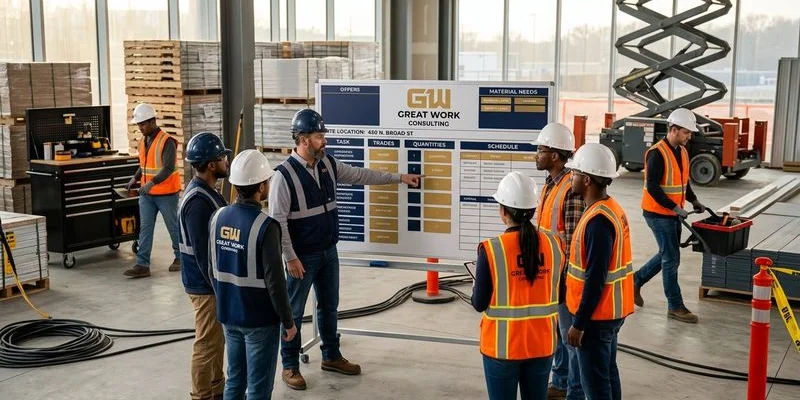
Our experience proves that spending 15 to 20 minutes every morning confirming the plan eliminates the majority of communication breakdowns. This simple meeting prevents derailed projects and eroded margins.
Before crews leave the yard, cover these items:
- Which crew goes to which job site.
- What specific tasks are being completed today.
- What materials and equipment are confirmed on site.
- Expected challenges like weather or pending inspections.
We highly recommend replacing the basic morning group text with purpose-built field apps like Kraaft or Fieldwire. Kraaft operates like a simple chat but structures the data, while Fieldwire connects daily tasks directly to blueprints.
Our clients who use these tools recapture lost labor hours immediately. At a loaded US labor rate of $55 per hour, saving just one wasted hour across three crews saves over $40,000 annually.
Job Scheduling That Prevents Bottlenecks
Our operations team views job scheduling as a constant balancing act between crew availability, supply chains, and customer expectations. A structured approach stops you from constantly reacting to preventable problems.
Build a Master Schedule
We suggest maintaining a master schedule that displays all active projects and the next three weeks of planned work. The discipline of updating it every single day matters more than the specific tool you choose.
Our consultants often help teams select the right software for this master view. A quick look at the numbers helps clarify the best fit for your specific needs.
| Software Option | Best For | 2026 Monthly Pricing | Core Strength |
|---|---|---|---|
| Buildertrend | Complex residential construction | $299 to $900+ | Advanced estimating and change orders |
| Jobber | Dispatch-heavy field services | $39 to $199 | Rapid scheduling and customer billing |
Scheduling Rules That Actually Work
We always tell contractors to limit concurrent project starts. Starting five jobs simultaneously and finishing none creates angry customers and burnt-out crews.
Our data shows that excessive heat reduces worker productivity by 10%. A 2025 study in Construction Management and Economics found that weather delays can extend US project timelines by up to 21%.
“Promising a completion date without a weather buffer guarantees a broken promise.”
We advise building two to three weather buffer days into every project to protect your timeline. This is especially true for hardscape work that requires dry conditions for base compaction and polymeric sand activation.
Our best practice is to front-load the difficult phases like demolition and excavation. Discovering unexpected soil conditions on day two is manageable, but finding them on day eight is a disaster.
Material Management That Prevents Delays
Our project managers constantly see material delays derailing outdoor living timelines. Missing irrigation fittings or backordered imported travertine pavers can force a crew to sit idle for days.
We implement a few non-negotiable habits to prevent these costly supply chain surprises. The first step is to order materials a minimum of three weeks before the project starts.
Prevent these problems with these clear steps:
- Order early: Avoid ordering the week of the project.
- Confirm 48 hours prior: Call the supplier to verify the delivery address and load status.
- Build a preferred list: Pay a slight premium for vendors who deliver reliably.
- Maintain safety stock: Keep base aggregate and polymeric sand in your own yard.
Our financial reviews reveal that delivery logistics can consume up to 30% of variable costs for paver block installations. Sending a crew member to the supply house mid-project kills an hour of productivity and destroys your margin.

Communication Systems That Prevent Costly Mistakes
Our audits reveal that more projects go sideways from communication failures than from poor craftsmanship. A crew missing a change order or an electrician showing up to an unprepared trench burns cash quickly.
Internal and Customer Updates
We require crews to use specific tools for real-time updates and daily logging. Using an app like CompanyCam centralizes job site photos with GPS and timestamps, which prevents disputes over existing damage.
Our standard practice is to document all change orders in writing before work begins. Verbal agreements for a patio extension lead directly to billing disputes.
We build these exact communication protocols through our operations consulting services. Proactive updates build trust, while reactive calls destroy it.
Handling Change Orders Without Losing Profit
Our financial reviews show that change orders are a normal but risky part of outdoor living projects. Recent 2026 industry data indicates that 35% of all US construction projects face at least one major change during execution.
We warn clients that unmanaged changes can drop a home builder’s profit margin from 15% down to just 12.6%. Hidden costs like project manager coordination time and schedule disruption easily eat up a standard 10% markup.
Build a simple change order process:
- Require the customer to request the change in writing.
- Document the exact scope change.
- Price the additional work with an updated margin.
- Secure written approval via email or text.
- Begin work only after receiving that approval.
Our advisors emphasize that financial clarity protects both your reputation and your referral pipeline. Establishing the right systems is the core focus of what we address in financial consulting.
Systems Create Freedom: Project Management Workflows That Keep Contractor Jobs on Track and on Budget
Our primary goal is to help you run projects on repeatable systems instead of your own memory. Waste decreases and profitability rises when operations are standardized.
We want to see your stress levels drop so you are no longer the single point of failure on every job site. Doing better work consistently allows you to step back and focus on business growth.
We are ready to help you implement project management workflows that keep contractor jobs on track and on budget.
Book a free Contractor Business Audit and start protecting your margins today.