Our team of professional service experts sees contractors struggle with online visibility every single day. This lack of visibility is exactly why we created Local SEO for Contractors: The Complete Guide to Dominating Google in Your Market to help talented builders thrive in 2026.
We understand that mastering local search is the dividing line between surviving and thriving. Data from Whitespark’s 2026 local ranking report shows that over 60 percent of clicks go straight to the top three Map Pack results.
Being buried on page two means you are virtually invisible to the homeowners and business owners searching for your exact services in the US. This guide breaks down the latest strategies for optimizing your profile, earning fresh reviews, and building a lead-generating foundation.
The time to claim your territory is now.
Local SEO for Contractors: The Complete Guide to Dominating Google in Your Market
For local service businesses across the US, Google is where buying decisions start. A staggering 76 percent of consumers who perform a “near me” search contact a business within 24 hours. Those high-intent homeowners and business owners are ready to hire immediately.
We constantly tell our clients that ranking in the Local Pack captures the lion’s share of these ready-to-buy clicks. Unlike paid ads or expensive lead platforms like HomeAdvisor, organic map optimization compounds over time. The work you do today will continue generating calls next year.
Our preferred approach focuses on building a passive lead generation system that outlasts any temporary paid campaign. This creates a predictable pipeline for your business.
Key Takeaway: In 2026, relying solely on paid ads is a costly battle. Local organic visibility provides the only sustainable way to build a predictable, long-term lead pipeline.
Step 1: Optimize Your Google Business Profile
The Foundation of Local Pack Visibility
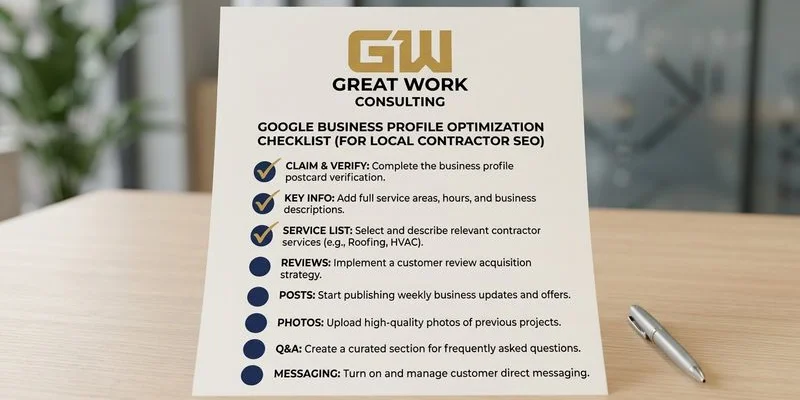
Your Google Business Profile is the absolute foundation of your local SEO strategy. Whitespark’s 2026 local ranking report confirms that profile completeness and engagement are the top factors for showing up in the Local Pack. We see contractors ignore this free asset all the time.
Essential Profile Elements to Master
You must complete every single field available in your dashboard. Google rewards complete profiles with better visibility for competitive US markets.
Our team recommends focusing heavily on these core areas:
| Profile Field | Basic Setup | Fully Optimized |
|---|---|---|
| Primary Category | Landscaper | Landscape Designer (Exact match) |
| Services | Blank | Detailed list with pricing and descriptions |
| Photos | Logo only | 10+ high-quality project and team photos |
Choosing the right primary category is critical for matching how customers actually search. A “Landscaping company” tag triggers entirely different results than a “Landscape architect” tag. We always add secondary categories like hardscaping or outdoor kitchens if the business provides those specific services.
The Power of Visuals and Weekly Activity
Uploading high-quality photos regularly makes a massive difference in conversion rates. Businesses with comprehensive photo galleries receive 42 percent more requests for directions and 35 percent more website clicks. You should upload project photos, team pictures, and before-and-after images every single month.
We also highly suggest writing Google Posts weekly to signal active engagement. These updates appear directly on your profile and show searchers that your business is busy and trusted. Share recent project completions, seasonal maintenance tips, or special promotional offers.
Step 2: Build NAP Consistency Across the Web
NAP stands for Name, Address, and Phone number. Google cross-references your business information across various US directories to verify your legitimacy.
We know that if your name is “Smith Landscaping” on Google but “Smith Landscaping LLC” on Yelp, that inconsistency severely hurts your rankings. Search engines view mismatched phone numbers or old addresses as major red flags.
Our typical process involves auditing client listings on the top tier directories. You need to verify your details on these crucial platforms:
- Yelp and the Better Business Bureau (BBB)
- Home service giants like Angi, Houzz, and Thumbtack
- Community networks like Nextdoor and Facebook
- Apple Maps and industry-specific association sites
We find that cleaning up these citations provides a quick trust signal to the search algorithms. Every single listing must match your main profile exactly.
Step 3: Earn and Manage Google Reviews
The Currency of Trust in 2026
Reviews are the second most important factor for local rankings and the absolute biggest conversion driver. A contractor with 47 five-star reviews will always beat a competitor with just three reviews. We look at BrightLocal’s 2026 consumer survey, which reveals that 31 percent of consumers will only hire a business with a 4.5-star rating or higher.
Why Recency Beats Quantity
Having a massive total number of reviews is great, but recency is actually the secret weapon. That same BrightLocal study shows that 74 percent of consumers only care about reviews written within the last three months. We have watched clients with 150 older reviews lose their map ranking because they stopped collecting fresh feedback.
Your pipeline needs a steady stream of new testimonials to maintain top positioning. Google views recent feedback as proof that your business is currently active and delivering excellent service to homeowners and business owners.
A Systematic Review Collection Process
Building a systematic collection process takes the guesswork out of reputation management. We help contractors automate this so they never miss an opportunity to capture a five-star rating.
- Ask every satisfied customer for feedback immediately at job completion.
- Follow up with an automated text containing a direct link to your page.
- Respond to every single review within 48 hours to show engagement.
- Never buy fake reviews because Google’s algorithm will penalize your listing.
Our data shows that 89 percent of consumers expect a business owner to respond to all feedback. Replying professionally to both positive praise and negative complaints proves you care about customer service.
Step 4: Create Location-Specific Content
If you serve multiple cities or neighborhoods, you must create dedicated content targeting each specific area. A page titled “Hardscaping Services in Austin” that includes local details and project examples signals strong relevance to Google. We always avoid just swapping city names on a generic template.
Your location pages must provide genuine value to the reader. Search engines are smart enough to recognize when a site is just stuffing location keywords into thin content.
Our content strategists focus on demonstrating true local expertise. You should mention neighborhood characteristics, regional permit requirements, or common climate considerations like dealing with clay soil in the Midwest.
| Content Approach | Example | Google’s View |
|---|---|---|
| The Lazy Template | ”We are the best landscaper in [City Name].” | Spammy and low value |
| The Expert Page | ”Native plant recommendations for Austin’s dry summers.” | Highly relevant and authoritative |
We recommend embedding a Google Map of your service area directly onto your contact page. This provides another layer of geographical proof to the search engine bots.
Step 5: Build Quality Backlinks
Backlinks from relevant, authoritative websites tell Google your business is trustworthy. Earning links from other US-based businesses or community organizations acts like a digital vote of confidence. We prioritize securing links that actually drive targeted local traffic.
Your focus should be on building relationships within your specific geographic market. National directories are fine, but local connections carry significantly more weight in 2026.
Our favorite backlink sources for contractors include these highly effective targets:
- Local business associations and regional chambers of commerce.
- Industry associations like the National Association of Landscape Professionals (NALP) or the Interlocking Concrete Pavement Institute (ICPI).
- Supplier and manufacturer partner pages where you buy materials.
- Local news websites covering your community involvement.
- Sponsorships of local events or youth sports teams like Little League baseball.
We strongly suggest reaching out to your material suppliers first. They are usually more than happy to link to their best contractors from a “preferred installers” page.
Step 6: Optimize Your Website for Local Search
Your website must support your off-page optimization efforts with solid technical foundations. A beautiful design means nothing if the search engine cannot understand where you operate or what you do. We audit technical elements constantly to ensure our clients are not losing ground to slow load times.
You need to implement these crucial on-page elements to dominate search results:
- Title tags that naturally include your service and target location.
- Schema.org markup, specifically utilizing the
HomeAndConstructionBusinessstructured data rather than generic local tags. - Mobile-first design, because over 60 percent of local searches happen on mobile devices.
- Fast loading speed, ensuring your site passes Google’s Core Web Vitals assessment.
- Service area pages detailing every specific region you cover.
Our developers find that adding a clickable “call now” button for mobile users drastically improves lead conversion rates. Make it as easy as possible for a homeowner with an emergency to reach you.
Common Local SEO Mistakes Contractors Make
Even experienced contractors shoot themselves in the foot by making easily avoidable digital errors. These mistakes can trigger a Google penalty or simply cause your listing to vanish from the Map Pack entirely. We have rescued countless profiles that were suspended due to simple oversight.
You must actively avoid these critical missteps:
- Ignoring Google Business Profile: Setting it up once and treating it like a static billboard.
- Using Fake Addresses: Trying to rank in a city by using a PO Box or virtual office, which poses a massive suspension risk.
- Inconsistent NAP Data: Publishing different phone numbers or business names across various directories.
- No Review Strategy: Hoping customers leave reviews naturally instead of actively asking for them.
- Keyword Stuffing: Cramming location names unnaturally into headers and paragraphs.
- Neglecting Mobile Users: Forcing visitors to pinch and zoom on a phone screen just to read your contact form.
Our team checks for these exact issues during our initial audits. Fixing these foundational problems often results in an immediate boost in visibility. Our marketing consulting for contractors addresses all of these local SEO challenges as part of a comprehensive lead generation strategy.
The Long Game
Organic search dominance is not a quick fix or an overnight hack. It typically takes three to six months to see significant results in competitive US markets.
We always remind contractors that the effort is an investment in their long-term equity. Once you build that solid foundation, the leads begin to compound.
An optimized profile, consistent citations, strong recent reviews, and highly relevant content work together as a 24/7 sales team. Our clients consistently tell us that organic leads offer distinct advantages over shared leads:
- They convert at a much higher rate.
- They carry stronger profit margins.
- They eliminate bidding wars with lower-quality competitors.
This methodical approach simply works.
Need help executing Local SEO for Contractors: The Complete Guide to Dominating Google in Your Market? Book a free Contractor Business Audit and our team will identify your biggest opportunities for organic growth.