Our professional service team works with business owners daily, and the main question is always how to build a lead generation system that replaces referral dependency. The reliance on word-of-mouth in this industry is staggering. A 2025 report from the Association of Professional Builders found that 54.8% of US contractors rely on referrals for over half their sales.
We know this feels safe since referrals close faster and cost nothing upfront. The problem is that word-of-mouth cannot be scaled or controlled.
When those organic recommendations slow down, your pipeline simply dries up.
Our strategy shifts the focus to a predictable, data-driven framework. Let’s look at the data, what it actually tells us, and explore practical ways to respond. The following sections outline the exact rollout plan to stabilize your growth.
Why Referral-Only Businesses Hit a Ceiling
We constantly see businesses hit a revenue ceiling when they exhaust their immediate network. Most contractors start with basic networking, which works well until it suddenly stops. Referrals are limited by the size of your existing customer base and their specific timing.
Our analysis shows that seasonal businesses are especially vulnerable to these network limits. Outdoor living contractors often lose two months of momentum during the winter off-season.
Bureau of Labor Statistics data from 2025 shows only 44% of US construction businesses survive past five years, largely due to this unpredictable cash flow.
- Cash flow instability: Waiting for calls creates feast-or-famine cycles.
- Limited reach: Your past clients only know so many people in your service area.
- Zero scalability: You cannot dial up word-of-mouth when you need more work.
We find that relying on past clients to act as your sales team is a massive risk. The modern US homeowner searches online before they ever ask a neighbor. Building a reliable system protects you from these seasonal dips.
How to Build a Lead Generation System That Replaces Referral Dependency: The Three Pillars
Our most successful clients build their operations on three distinct marketing pillars. A complete machine requires organic visibility, paid acquisition, and automated follow-up. These elements work together to bring in prospects whether or not someone recommends you.
Pillar 1: Organic Visibility (SEO and Content)
We treat search engine optimization as the absolute foundation of any modern contracting business. When a US homeowner searches for a patio contractor, your company needs to appear first. Organic search delivers incredible value over time.
Our recent internal data aligns perfectly with 2026 industry benchmarks. Organic search produces leads at a 57% lower cost than paid advertising across the home services sector. A well-optimized presence can generate inquiries for years without additional ad spend.
We recommend focusing on four essential organic assets to establish local dominance. You need a complete Google Business Profile with weekly photo updates. Your website must include service-specific landing pages that target exact buyer phrases.
- Google Business Profile: This drives local map pack rankings.
- Targeted landing pages: These capture specific intent.
- Educational blog content: This builds trust and authority.
- Local citations: These verify your business across the web.
Our team uses tools like Google Search Console to track these organic improvements accurately. This compounding effect makes SEO the most profitable long-term strategy. Learn more about building your organic presence in our marketing consulting services.

Pillar 2: Paid Acquisition (Google Ads and Social)
We use paid advertising to generate immediate traction while the SEO strategy builds momentum. Google Ads and Meta Ads are the two most effective channels for immediate US market penetration. The exact platform you choose depends on the type of demand you want to capture.
Our preferred approach for capturing existing demand is Google Local Services Ads. These ads appear above traditional search results and run on a pay-per-lead model.
A 2026 B&G Collective report notes the average cost per remodeling lead on US Google Ads ranges from $90 to $140.
We pivot to Meta Ads Manager when the goal is creating new demand. Stunning project photos on Instagram inspire property owners who were not actively searching. These visual campaigns require more nurturing but often result in a much lower cost per acquisition.
Our cardinal rule for paid media is to track your numbers religiously. You must know your cost per inquiry, cost per estimate, and customer acquisition cost. Spending $150 per click is profitable if you close one in five at an average $15,000 job value.
Pillar 3: Automated Follow-Up
We constantly watch companies leave money on the table due to poor response times. Speed-to-lead dictates who wins the project in the highly competitive home services space. A 2026 LeadAngel study found that responding within 5 minutes makes you 21 times more likely to qualify a prospect.
Our research shows the average US business response time is a dismal 47 hours. In fact, nearly 43% of website inquiries never receive any response at all. You cannot be glued to your phone while running a crew, which makes software essential.
We implement automation to ensure no opportunity falls through the cracks. You should set up specific triggers to engage the prospect instantly. An effective sequence completely removes the burden from your field crew.
- Instant SMS: Send a text response within 60 seconds of submission.
- Email Nurturing: Provide educational value over the following weeks.
- Direct Scheduling: Use calendar links to eliminate back-and-forth messaging.
Our favorite CRM tools, like HubSpot or Jobber, provide appointment booking links to eliminate phone tag. A proper system separates contractors who close 40% of their inquiries from those who close 15%. Check out our guide on CRM and marketing automation for specific implementation details.
Building Your Lead Tracking Dashboard
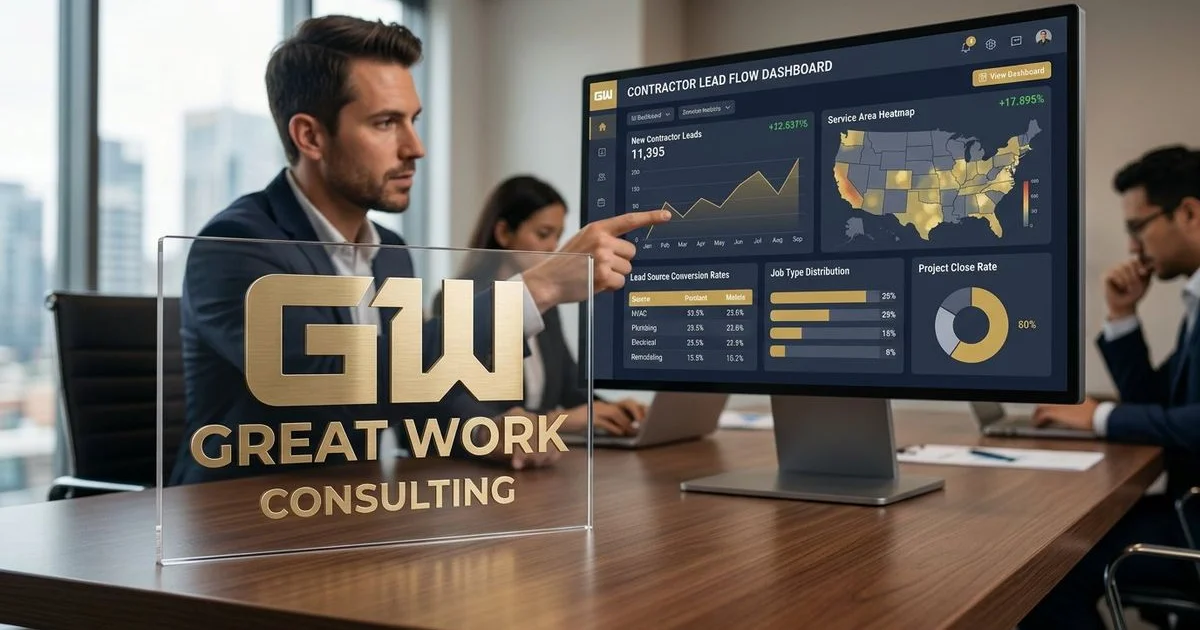
We operate on the principle that you cannot improve what you do not measure. Relying on native ad platform metrics often paints an incomplete picture of your actual profitability. Third-party trackers like CallRail or ServiceTitan connect marketing spend directly to closed revenue.
Our standard dashboard requires tracking six specific key performance indicators every single month. This data allows you to make intelligent decisions about where to invest your budget. Accurate tracking reveals true efficiency, even when upfront costs appear high.
| Metric to Track | Why It Matters | 2026 US Benchmark |
|---|---|---|
| Total Inquiries Generated | Shows the raw volume produced by each channel. | Varies by budget |
| Cost Per Lead (CPL) | Measures the immediate efficiency of ad spend. | $90 - $140 (Google Ads) |
| Estimate Conversion Rate | Highlights the quality of the incoming traffic. | 30% - 50% |
| Estimate-to-Close Rate | Reveals the effectiveness of your sales process. | 20% - 40% |
| Average Job Value | Determines how much you can afford to spend on ads. | Varies by trade |
We highly recommend comparing these metrics side-by-side. If Google generates $100 inquiries and you close one in four, your acquisition cost is $400. If Meta generates $50 inquiries but you close one in ten, Google is actually more efficient.
The 90-Day Implementation Plan
Our advice is to avoid building the entire machine in a single weekend. A phased approach prevents operational overwhelm and ensures each component functions correctly. This realistic 90-day rollout creates a sustainable foundation.
Days 1-30: Infrastructure and Quick Wins
We prioritize setting up your CRM and automated follow-up sequences first. Tools like Zapier can connect your forms directly to your database without manual entry. You must also optimize your Google Business Profile to capture immediate local traffic.
Days 31-60: Paid Acquisition Launch
We suggest launching your first Google Ads campaign targeting your highest-margin services during month two. Start with a modest budget of $50 to $100 per day to test the US market. Review the data weekly and refine your keyword targeting to reduce wasted spend.
Days 61-90: Long-Term Asset Creation
We focus the final phase on content marketing and search engine strategy. Publish your core service area pages and utilize tools like Semrush to guide your blog topics. These assets take time to rank, but you are planting seeds for massive future growth.
Stop Being a Referral-Dependent Business
Our most profitable clients still get plenty of organic recommendations. They simply refuse to depend on them as their sole source of new work. They rely on predictable systems that follow up automatically and convert consistently.
We know that building this infrastructure takes concentrated effort upfront. Once it runs smoothly, you will escape the exhausting feast-or-famine cycles forever. You will enjoy a steady flow of qualified prospects instead of hoping the phone rings.
Our team is ready to help you map out a custom strategy to replace this dependency. Ready to learn how to build a lead generation system that replaces referral dependency? Book a free Contractor Business Audit to start your growth journey today.