When researching how to value a contractor business: what buyers actually look for usually surprises even the most experienced US owners. Most carry a vague number in their head regarding their company’s actual worth. This figure usually stems from annual revenue or a rumor about what a competitor sold for recently.
Our professional service team knows that skipping a formal valuation process is a costly mistake. That lack of clarity costs real money when the time comes to sell, bring on a partner, or plan for retirement.
Understanding these financial metrics provides a roadmap for building a more profitable company today. The factors driving valuation are the exact same factors driving daily stability and your quality of life.
We will outline exactly what buyers evaluate during an acquisition. Let’s examine the data and explore practical ways to position your firm for a premium multiple.
The Foundation: EBITDA and Seller’s Discretionary Earnings
We evaluate earnings first because business valuation always starts there. For US contractor businesses, the two most common earnings metrics are EBITDA (Earnings Before Interest, Taxes, Depreciation, and Amortization) and SDE (Seller’s Discretionary Earnings). These figures tell buyers the true financial health of your operation.
EBITDA serves as the standard metric for businesses with $1 million or more in annual earnings. It represents operating profit before financing and accounting decisions. Buyers use EBITDA because it shows the true earning power of the business independent of debt structures.
SDE is more common for smaller contractor businesses. This metric takes EBITDA and adds back the owner’s salary, personal benefits run through the company, and one-time expenses. Small Business Administration (SBA) lenders specifically look at SDE to ensure a business can easily service acquisition debt. This calculation gives a buyer a complete picture of the total economic benefit provided by the business.
For most outdoor living contractor businesses generating $1 million to $5 million in revenue, SDE remains the relevant metric. Above that threshold, EBITDA becomes the standard. We often see capitalization of earnings cap rates range from 20% to 25% for companies with consistent SDE cash flow.
| Metric | Target Business Size | Key Components | Primary Use Case |
|---|---|---|---|
| SDE | Under $1M Earnings | Net Profit + Owner Salary + Personal Expenses | SBA Loans, Individual Buyers |
| EBITDA | Over $1M Earnings | Operating Profit (Pre-Tax/Interest/Depreciation) | Private Equity, Corporate Acquisitions |
What Multiples Do Contractor Businesses Trade At
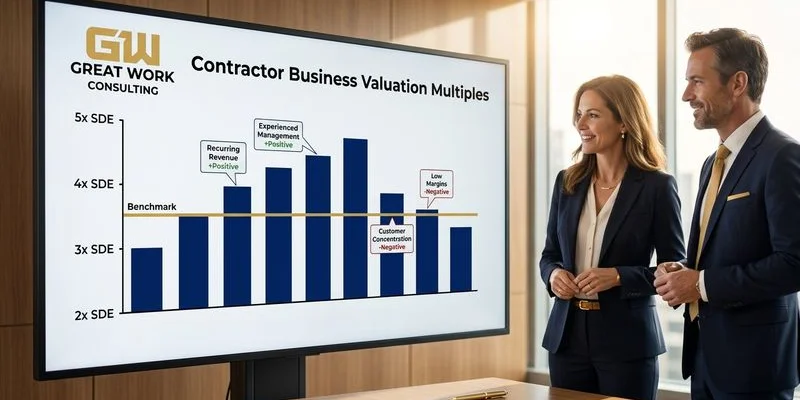
Contractor businesses typically sell for 2x to 5x SDE. Where your business falls within that wide range can mean a difference of hundreds of thousands of dollars. Recent 2025 BizBuySell data shows US specialty contractors trade at an average earnings multiple of 2.66x.
We want to help you push your company toward the top of that scale. The difference between a low and high multiple comes down to risk reduction and predictable cash flow.
- Lower end (2x to 3x SDE): Businesses that are heavily owner-dependent often land here. These companies have inconsistent revenue, lack documented systems, and rely on a small number of customers.
- Middle of the range (3x to 4x SDE): This category includes businesses with stable revenue and documented processes. A management team handles daily operations while maintaining a diversified customer base and healthy profit margins.
- Upper end (4x to 5x SDE): Companies in this tier feature recurring revenue streams and strong brand recognition. Industry data shows businesses with more than 70% recurring revenue often achieve 1.5x to 2.5x higher multiples than project-based competitors.
How to Value a Contractor Business: What Buyers Actually Look For When Assessing Risk
1. Owner Dependency
Owner involvement is the single biggest factor determining whether your business sells at a premium or a discount. If you act as the primary salesperson, estimator, and project manager, your business is essentially just you with employees attached. Buyers see enormous risk in that arrangement.
Recent studies show owner-dependent businesses lose 20% to 50% of their value during sale negotiations. Buyers worry the company will simply collapse when you leave the transition period. They discount the purchase price to account for that specific risk.
We ask our clients to pass a simple four-week test. Can your business operate fully for four consecutive weeks without your direct involvement? For a detailed guide on building management systems, read our post on reducing owner dependency in your contractor business.
2. Revenue Consistency and Growth Trajectory
Buyers want to see stable and growing revenue over a three-to-five-year period. A contractor business that produced $2 million, $2.3 million, $2.5 million, and $2.8 million over four years looks fantastic. That steady climb is far more attractive than a company bouncing randomly between $1.8 million and $3 million.
Consistency demonstrates strong market demand and operational reliability. Seasonal fluctuation is fully expected in outdoor living businesses. Buyers evaluate whether the business manages that seasonality effectively through diversified services or commercial contracts.
We find that buyers strongly prefer companies with a balanced revenue mix. A ratio of 40% to 50% recurring service work paired with 50% to 60% installation projects provides highly predictable cash flow. Maintaining an efficient customer acquisition cost below $1,500 also proves your growth trajectory is sustainable.
3. Profit Margins
Revenue is vanity, but profit is reality. A $3 million contractor business with 8% net margins is worth significantly less than a $2 million business with 18% net margins. Buyers pay for actual profit rather than top-line revenue.
Our experience shows that healthy net profit margins for US contractors typically range from 10% to 20%. Recent Construction Financial Management Association (CFMA) data indicates the average industry profit often sits much lower due to inefficiency. If your margins fall below that ideal range, you likely have issues to fix immediately.
- Pricing Strategy: Moving away from time-and-materials billing toward flat-rate pricing often improves margins drastically.
- Job Costing: Track your direct labor and materials accurately on every single project.
- Overhead Management: Keep fixed operational expenses below 30% of your total revenue to protect net profitability.
Improving these margins directly increases your valuation through higher earnings.
4. Customer Concentration
Buyers immediately identify customer concentration as a major financial risk. If any single client represents more than 15% of your revenue, the valuation multiple will likely drop. What happens to the company if that major customer leaves after the acquisition?
For contractors serving residential markets, individual homeowner projects are naturally diversified. Commercial contractors face a much higher risk of concentration.
We recommend ensuring your top five customers stay under 40% of your total combined revenue. Diversifying your client base protects your cash flow and reassures nervous buyers.
5. Documented Systems and Processes
Buyers are purchasing the machine that produces your revenue stream. If that machine exists entirely in your head, the business is completely untransferable. Documented systems for estimating, project management, and customer communication make a business valuable.
A company with a 200-page operations manual and a trained staff is worth materially more than a business with zero documentation. Companies with independent, documented systems are three times more likely to sell at or above their asking price.
We see the best results when contractors implement dedicated field service management software. Platforms like ServiceTitan work well for scaling large operations, while Jobber provides excellent scheduling and invoicing tools for teams under 15 people. These digital systems ensure your operational consistency transfers easily to a new owner.
6. Team Quality and Retention
A skilled and stable workforce serves as one of your hardest assets to build. Businesses with experienced crews and low turnover rates always command higher valuations. Buyers know that replacing skilled US tradespeople is incredibly expensive and disruptive to production.
High technician turnover raises an immediate red flag for acquiring parties. It indicates underlying operational problems and introduces massive integration risk.
We often see buyers protect themselves by structuring the sale with earn-outs. These earn-out payments are frequently tied directly to key technician retention during the first 12 to 24 months post-sale. Building a positive company culture now ensures you collect your full payout later.
7. Financial Cleanliness
Many contractor businesses run personal expenses through the company or keep incomplete records. These practices might save a few tax dollars in the short term, but they destroy immense value at sale time. Buyers and their accountants require clean, accurate financial statements going back at least three years.
If your books are a mess, you should expect a significantly lower multiple and a painfully long sale process. Clean financials also help you secure better deal structures, such as receiving 75% cash at closing rather than accepting a risky seller note.
Working with a qualified accountant to clean up your books is a high-return investment. Our financial consulting services specialize in helping contractors build this exact financial foundation.

How to Increase Your Valuation Starting Today
You do not need to plan a sale next year to benefit from a valuation-focused mindset. The exact actions that increase your multiple also make your business vastly more profitable and enjoyable to run today.
We suggest focusing on several high-impact areas immediately.
- Clean up your financials: Separate personal and business expenses completely. Produce accurate monthly statements and track job costing by project.
- Optimize pricing strategy: Implement tiered options, sometimes called a good-better-best strategy, to capture higher ticket values without needing more leads.
- Build your management layer: Hire an operations manager who can handle daily decisions without your permission.
- Document everything: Create standard operating procedures for estimating, crew management, and customer communication.
- Invest in transferable marketing: Build lead generation systems like SEO, paid advertising, and CRM and marketing automation. A machine generating 50 qualified leads per month acts as a tangible asset for buyers.
When to Get a Professional Valuation
We recommend securing a formal valuation at least 12 to 24 months before any planned exit. This timeline provides you enough runway to identify operational gaps and demonstrate measurable progress.
A professional valuation establishes a concrete baseline for tracking your value creation. It also allows your accounting team to execute proper tax planning, which often requires a full 24-month lookback period to secure favorable capital gains treatment.
Even if you plan to keep the company, knowing your actual business value is fundamental. It directly impacts your retirement projections, partnership negotiations, and estate planning. For comprehensive guidance on building a premium company, visit our exit strategy and business valuation consulting page.
The Valuation Equation in Plain Language
Understanding how to value a contractor business: what buyers actually look for comes down to minimizing risk. Your contractor business is simply worth what a willing buyer will pay for it.
That final number is determined by your total earnings, the predictability of your cash flow, and the simplicity of the ownership transition.
We know that every action you take to reduce risk directly increases your valuation multiple. Start treating your business like a scalable asset today. The result will be a highly organized, wildly profitable, and easily transferable company.
Ready to uncover your company’s true value? Book a free Contractor Business Audit and we will build a strategic roadmap to maximize your exit price.