We often see contractors pouring thousands into marketing, only to struggle with mastering The Contractor Sales Funnel: From First Lead to Signed Contract.
The phone rings, leads come in, and you find yourself quoting a $30,000 outdoor living project to absolute silence.
Our team knows this frustration well, especially when you follow up once or twice before moving on. The truth is, your leads are probably fine. We have found that the real culprit is usually the absence of a structured sales funnel. Relying on disconnected interactions and hoping for the best simply does not work in today’s market.
Our goal here is to help you map out a deliberate process that transforms initial inquiries into signed agreements. Let’s examine the data behind successful conversions, break down the core stages of a modern pipeline, and explore specific ways you can stop leaving money on the table.
Understanding The Contractor Sales Funnel: From First Lead to Signed Contract
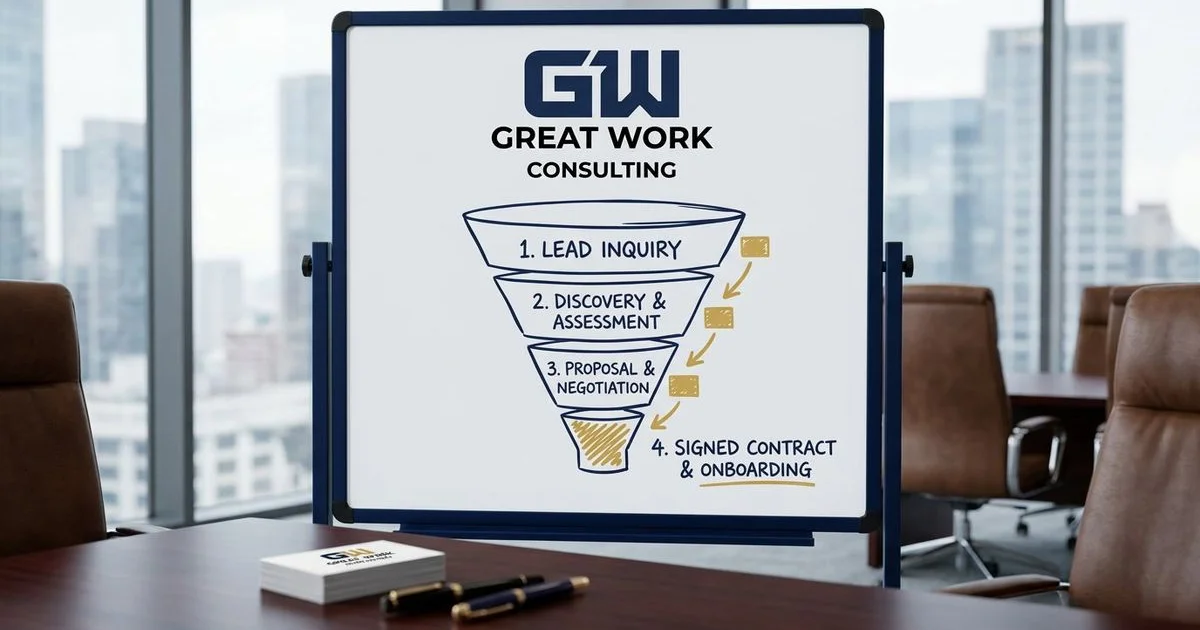
Our experience shows that every successful home service sale follows a specific five-step path. Whether you intentionally track it or not, your prospects are moving through these distinct phases. We categorize these stages to clearly identify where potential revenue slips away.
Here are the five milestones every customer must pass:
- Lead Capture: The prospect reaches out.
- Qualification: You determine if they are a fit.
- Estimate/Proposal: You present your solution and price.
- Follow-Up: You nurture the decision.
- Close: They sign the contract.
We notice that most construction companies handle the first and third steps fairly well. Answering the phone and emailing a price quote are basic habits.
Our data indicates the real drop-offs happen during qualification, follow-up, and the final close. A structured system plugs those leaks and maximizes the return on your marketing spend.
Stage 1: Lead Capture That Doesn’t Lose Leads

We cannot overstate the importance of immediate action when a new inquiry hits your inbox. A staggering 88% of US homeowners now expect a response within 24 hours, according to a 2026 Scorpion survey. Our standard recommendation used to be a five-minute response window, but the market has shifted dramatically.
Recent 2026 industry benchmarks show that contacting a lead within 60 seconds increases your conversion odds by an incredible 391%. We know that waiting just 30 minutes decreases your chance of qualifying that prospect by 21 times. Speed is the absolute biggest competitive advantage, so you need highly efficient systems in place.
Systems for Instant Response
We build specific automated workflows to ensure no opportunity goes cold. Set up these essential tools to capture attention immediately:
- Automated text response: Fires within 60 seconds of a web form submission.
- A dedicated phone number: Routes to whoever is available, rather than just the owner.
- A CRM system: Logs every single lead with the source, contact info, and timestamp.
- A voicemail script: Sets firm expectations for callback timing.
Stage 2: Qualification That Saves You Time
We strictly filter inquiries because not every phone call deserves an on-site visit. Driving 45 minutes to quote a $75,000 backyard transformation is vastly different than bidding on a simple $5,000 paver walkway. Our teams use qualification frameworks to protect your schedule and focus your energy on high-value buyers.
With Kupa Web Solutions noting that up to 80% of unvetted leads in 2026 might be tire-kickers with unrealistic budgets, pre-screening is non-negotiable. We suggest building a standardized script for anyone answering your phones.
Essential Qualification Questions
A strong pre-screening process should uncover these crucial details:
- Project scope: What are they looking to build or fix?
- Timeline: When do they actually want to start the work?
- Budget range: Have they researched pricing, and are they comfortable with typical 2026 costs?
- Decision makers: Will all property owners be present for the walkthrough?
- Previous estimates: Have they already talked to other local contractors?
We view this step as a mutual display of respect, not a pushy sales tactic. Discovering someone expects a $50,000 pool for $15,000 over the phone saves you hours of wasted effort.
Stage 3: Presenting Estimates That Win
Our approach treats every proposal as a strategic sales document rather than a simple price tag. How you deliver your numbers directly determines your success rate. We always push for in-person presentations whenever logistically possible.
Emailing a raw spreadsheet and hoping for a positive reply is a weak strategy. We rely on face-to-face meetings to read body language and overcome objections instantly. Homeowners making large investments need visual tools like 3D renderings and material samples to feel confident.
Structuring Your Proposal for Success
We consistently present tiered pricing to shift the focus from cost to value. Giving a buyer good, better, and best options creates a sense of control and prevents them from shopping your single price against a competitor. Our proposals also heavily feature local social proof.
A 2026 Scorpion survey revealed that 87% of homeowners will ignore a business rated below four stars. We combat this by embedding two or three localized testimonials and recent before-and-after photos directly into the estimate. For detailed guidance on creating winning proposals, explore our marketing consulting services.
Stage 4: Follow-Up That Closes Deals
We see contractors abandon perfectly good prospects simply because the buyer did not sign on day one. Hubspot data reveals that 80% of sales require five or more follow-ups, yet 44% of salespeople quit after a single attempt. Our internal tracking confirms that the homeowner is usually just busy comparing options or talking to their spouse.
Recent metrics from Contractor Accelerator show that teams making 12 contact attempts perform 20% better than those stopping at eight. We implement structured follow-up sequences to stay visible without becoming an annoyance. The current 2026 best practice is an SMS-first approach, as many younger homeowners heavily screen unknown phone numbers.
The 30-Day Follow-Up Sequence
We recommend mapping out a clear timeline for your outreach. Consider this proven schedule:
- Day 1: Send the estimate with a personalized thank-you message.
- Day 3: Text to ask if they have any immediate questions.
- Day 7: Email a portfolio showcase featuring a project similar to theirs.
- Day 14: Share a video testimonial from a satisfied client in their specific zip code.
- Day 21: Make a personal phone call to check their current interest level.
- Day 30: Provide a final nudge based on your upcoming seasonal capacity.
We automate the text messages and emails through a CRM to ensure absolute consistency. Personal phone calls, however, add the human touch that separates professionals from automated spam.
Stage 5: Closing With Confidence
We firmly believe that closing should feel like a natural next step if you executed the previous stages correctly. The prospect already trusts your expertise and understands the clear value of your work.
We find that the final conversation is simply about clearing away any lingering hesitation. Addressing common industry barriers head-on prevents last-minute cancellations.
Overcoming Final Objections
We train sales teams to proactively handle these specific hurdles. Every contractor should be prepared for the following common scenarios:
- Price anxiety: Remind them of the value, the warranty, and the quality, while showing them what cheap alternatives look like.
- Timing concerns: State clearly that starting in March means they will be enjoying their new patio by Memorial Day, but waiting pushes the project into July.
- Spouse buy-in: Always present to both decision makers together so no details get lost in translation.
- Deposit concerns: Explain exactly where the deposit goes, such as materials ordering, and reference your strong reviews and state licensing.
We tell contractors to ask for the business directly. A simple question like, “Are you ready to move forward with option two so I can get you on our schedule for next month?” works perfectly.
Measuring Your Funnel Performance
We track specific performance metrics every month to locate exact bottlenecks in a company’s pipeline. Without hard data, you are essentially guessing about the financial health of your business.
We look at 2025 data from Greenbaum Stiers, which shows top-performing US contractors achieving an average close rate around 29.8%. You can establish your own reliable baseline by monitoring these key indicators:
| Funnel Metric | Performance Target | What It Actually Measures |
|---|---|---|
| Lead-to-Appointment Rate | 60%+ | Reveals the effectiveness of your initial response speed. |
| Appointment-to-Estimate Rate | 90%+ | Highlights how well your pre-screening qualification works. |
| Estimate-to-Close Rate | 30% - 40% | Indicates the strength of your in-person presentation and follow-up. |
| Average Time to Close | Varies by project | Shows the true length of your sales cycle from first inquiry to signature. |
We use these exact numbers to reverse-engineer annual revenue goals. Converting 100 leads into 60 appointments, sending 55 estimates, and closing 16 deals yields a 16% total close rate, showing exactly how much volume you need to succeed.
Your Sales Funnel Is Your Growth Engine
We consistently see that a team closing 35% of their bids will dominate a competitor closing at 15%. Your pipeline is the primary multiplier that makes every single advertising dollar work significantly harder.
We urge you to build this system, train your staff, and relentlessly refine The Contractor Sales Funnel: From First Lead to Signed Contract. Taking control of your process shifts your business from desperately chasing work to selectively choosing the best projects.
We are here to support your transition into a highly efficient operation. Ready to build a sales funnel that converts more leads into signed contracts? Book a free Contractor Business Audit and we’ll identify the gaps in your current process and show you exactly how to fix them.